
You have selected the right power topology, sized the converter for your electrolyzer or charging load, and confirmed grid compatibility. Now comes a decision that can shift your project budget by 60–120% and your installation timeline by weeks: how will the power supply be deployed on site?
The choice between a containerized AC/DC power supply and a non‑containerized (open skid or site‑built) approach is about more than just a metal box. It affects site preparation costs, environmental protection, maintenance access, scalability, and the total cost of ownership over the equipment’s lifecycle.
This guide breaks down the practical differences between these two deployment models. The goal is not to declare one “better” than the other, but to provide a decision framework based on your specific project constraints—site location, timeline, budget, and future expansion plans.
Understanding the Two Deployment Models
Before comparing pros and cons, it is useful to clarify what each approach actually means in practice.
Containerized AC/DC Power Supply
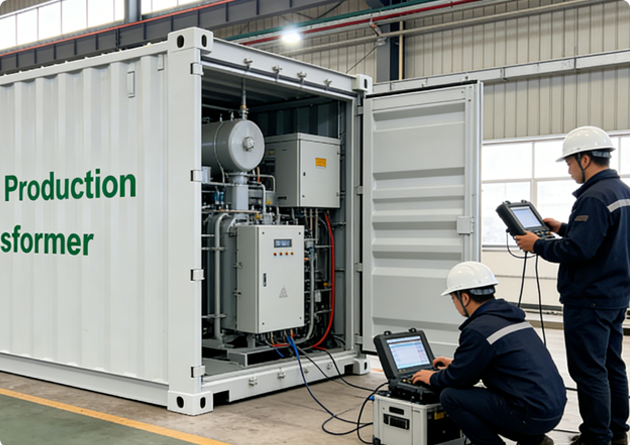
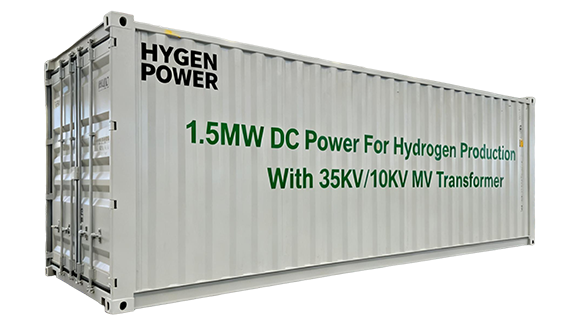
A containerized power supply houses all critical components—rectifiers, control systems, cooling, switchgear, fire suppression, and auxiliary systems—within a standard ISO shipping container (typically 20‑foot or 40‑foot). The entire system is factory‑assembled, pre‑wired, and factory‑tested before delivery.
Key characteristics:
-
Self‑contained and weatherproof—requires no dedicated building
-
Integrated cooling, ventilation, and fire protection
-
Designed for lifting, stacking, and long‑distance transport
-
Plug‑and‑play philosophy: connect input power and output cables, and the system is ready
Non‑Containerized (Open Skid / Site‑Built) Power Supply
A non‑containerized approach typically refers to an open skid configuration—the engine, alternator, control system, and auxiliaries mounted on a common steel base frame with no external enclosure. In other cases, it may involve custom‑built components installed within a dedicated generator room or power house.
Key characteristics:
-
Components are exposed or require a separate building for protection
-
Lower initial equipment cost
-
Requires site‑built infrastructure (foundation, room, ventilation, fire suppression)
-
Components can be customized and laid out flexibly within available space
A 2025 analysis by Siemens and Delta found that prefabricated, modular power systems can cut deployment times by up to 50% and lower capital expenditure by up to 20% compared to traditional construction methods. This gap is precisely what the containerized vs. non‑containerized decision aims to address.
For projects where deployment speed and site simplicity are critical, review Containerized Hydrogen Power Supply for modular deployment to understand how factory‑integrated systems compare to field‑assembled alternatives.
Head‑to‑Head Comparison – Key Decision Factors
The following comparison focuses on the factors that most directly impact project outcomes. Each factor is explained in terms of what it means for your budget, timeline, and operational risk.
| Decision Factor | Containerized Approach | Non‑Containerized (Open Skid / Site‑Built) |
|---|---|---|
| Equipment cost | Higher upfront—typically a 60–120% premium over a bare skid | Lower initial procurement cost |
| Site preparation | Minimal—pour a concrete pad ($10,000–$40,000 total) | Significant—generator room with fire rating, ventilation, lighting, fire suppression ($50,000–$200,000+) |
| Installation timeline | Weeks—set container, connect the power and signal cables | Months—build room, install components, field wire everything |
| Environmental protection | Fully enclosed—resists rain, dust, salt spray, humidity | Relies on building—if building fails, equipment is exposed |
| Noise level | 70–85 dB(A) with integrated soundproofing | 85–100 dB(A) without enclosure; may exceed OSHA limits |
| Maintenance access | Internal access via container doors—may be tighter | 360‑degree access—easier for large component servicing |
| Scalability | Modular—add parallel containers as demand grows | Requires new building space or room expansion |
| Transportability | ISO‑compliant—lift and ship as a complete unit | Components shipped separately; reassembly required on site |
| Factory testing | Fully tested before delivery—reduces on‑site surprises | Testing occurs after installation—issues discovered late |
What These Differences Mean for Your Project
The “cheaper” option on paper is not always the cheaper option in practice. An open skid may cost $75,000, but adding a fire‑rated generator room can push the total installed cost to $125,000–$275,000. A containerized unit at $120,000–$165,000 with a $10,000–$40,000 pad often becomes the more economical path to a fully code‑compliant installation.
Similarly, a 2000kW open skid producing 103 dB(A) exceeds the OSHA 8‑hour permissible exposure limit of 90 dB(A). Achieving acceptable noise levels with an open skid requires either a sound‑attenuated building (additional cost) or an aftermarket enclosure—both of which erode the initial cost advantage.
When Each Approach Makes the Most Sense
Containerized Approach Is Typically Preferred When:
Your site is remote or harsh. Containerized units are purpose‑built for extreme environments—offshore platforms, mining sites, desert locations with extreme temperatures, or coastal areas with salt spray. The ISO container provides structural protection while housing climate control systems that maintain safe operating conditions.
You need rapid deployment. If your project timeline is measured in weeks rather than months, a containerized solution that arrives fully assembled and tested eliminates the long lead times of site construction.
You value factory quality control. Field‑wired, site‑built installations have higher defect rates than factory‑assembled, pre‑tested systems. Containerized solutions ship with factory test reports—you know what you are getting before it arrives.
Future expansion is planned. Containerized systems are modular by design. Additional containers can be added in parallel without redesigning the entire system. This “pay‑as‑you‑grow” approach avoids high upfront oversizing costs.
Space is at a premium. A containerized unit occupies a defined footprint and can be placed outdoors, freeing up indoor space for other operations.
Non‑Containerized Approach May Be Suitable When:
You already have a dedicated generator room or power house. If the building infrastructure already exists, the incremental cost of installing an open skid is minimal. There is no need to pay for a container enclosure you do not require.
You need maximum maintenance accessibility. Open skids provide 360‑degree access to all components. For facilities with dedicated maintenance teams and ample workspace, this can translate to faster routine service.
You have a very tight equipment budget and existing infrastructure. If the project cannot absorb the higher upfront cost of a containerized unit—and the site already provides protection from weather and noise—an open skid can be a viable lower‑cost entry point.
Custom layout is required. Some sites have unusual space constraints or require specific component spacing that a standard container cannot accommodate. A site‑built approach offers maximum layout flexibility.
For green hydrogen plants and electrolysis facilities planning multi‑MW deployments, containerized power conversion systems have become increasingly common. A 5 MW containerized rectifier system can be delivered as a standardized, plug‑and‑play solution designed to simplify site execution while supporting stable DC power and grid‑friendly performance. Explore containerized power system configurations for electrolysis applications to see how this approach is being applied in hydrogen production projects.
Real‑World Scenario – Two Projects, Two Approaches
Scenario A: Remote Mining Site, 2 MW Backup Power
A mining operation 200 km from the nearest city needs a 2 MW AC/DC power supply for a new processing line. The site has no existing power house. Ambient temperatures range from -5°C to 45°C. Dust is a constant challenge.
Decision: Containerized approach.
Rationale: Building a generator room in a remote location would require transporting materials, hiring local contractors, and managing extended construction—all at premium cost. A containerized unit arrives on a truck, is lifted onto a prepared pad, and is operational within days. The integrated cooling and filtration systems handle the harsh environment without additional site work.
Scenario B: Existing Industrial Facility, 500 kW Expansion
A manufacturing plant has an under‑utilized equipment room adjacent to the main production floor. The room has power, ventilation, and fire suppression already installed. The plant needs an additional 500 kW DC power supply for a new electrolysis pilot line.
Decision: Non‑containerized (open skid).
Rationale: The existing room eliminates the need for weather protection or noise abatement. An open skid can be installed directly on the room’s floor, connected to existing bus bars, and commissioned with minimal civil work. The lower equipment cost is a genuine saving because the infrastructure is already paid for.
Beyond the Initial Decision – Lifecycle Considerations
The choice between containerized and non‑containerized does not end at installation. Consider these long‑term factors:
Relocation and redeployment. Containerized units can be lifted, transported, and redeployed at a different site if project needs change. An open skid installed in a dedicated room is effectively permanent.
Technology upgrades. As power conversion technology evolves, a containerized unit can be swapped out entirely—new container in, old container out. Upgrading a site‑built system often requires piecemeal replacement of components within an existing room layout.
Resale value. Containerized power systems retain value as complete, tested assets that can be sold or leased to other projects. A site‑built installation has little resale value beyond scrap.
Regulatory compliance. Containerized units are designed to meet international standards (ISO, IEC) and can be deployed across jurisdictions with consistent compliance. Site‑built systems must meet local building codes, which vary significantly.
If your organization operates multiple sites or anticipates changing power demands over time, the modularity and transportability of containerized solutions offer strategic flexibility that a site‑built approach cannot match. Review hydrogen fuel cell power supply system for multi‑site deployment to understand how standardized containerized platforms can simplify fleet operations.
From Comparison to Selection – Making Your Decision
The containerized vs. non‑containerized decision is ultimately a question of trade‑offs:
-
If speed, simplicity, and environmental protection are your priorities → containerized offers a proven, factory‑tested path
-
If you have existing infrastructure and maximum equipment access is critical → non‑containerized may be the practical choice
-
If your project is in a remote or harsh location → containerized solution is strongly recommended
-
If you are operating in a controlled indoor environment with ample space → an open skid can deliver the same electrical performance at lower equipment cost
The “right” answer depends on your site, your timeline, and your long‑term operational strategy. Many project teams find that the total installed cost—not the equipment cost alone—is the deciding factor. When site preparation, building construction, and field labor are factored in, containerized solutions often prove more economical over the full project lifecycle.
Once you have clarified these key decision factors—site conditions, timeline, expansion plans, and maintenance philosophy—comparing the specific specifications of available power supply options becomes the next logical step. You can review containerized configurations for high‑capacity scenarios or open skid designs for facilities with existing power house infrastructure.
Related Reading
To deepen your understanding of power supply deployment and integration for green energy projects, explore these related topics:
-
Cooling System Design for High‑Power Rectifiers
-
Grid Integration and Harmonic Filtering for Electrolysis Power Supplies
-
Modular Power System Architecture – Scaling from MW to Multi‑MW
-
Site Preparation Checklist for Containerized Power Installations