
You have deployed a 2MW liquid-cooled EV charger for your fleet—but how do you keep the cooling system reliable over years of operation? Unlike air-cooled systems, where you can visually check fans, liquid cooling involves sealed loops, coolant chemistry, pumps, and heat exchangers that require a structured inspection schedule.
This guide provides a practical, tiered framework for determining how often to inspect each component of your 2MW charger’s liquid cooling system—from daily visual checks to annual overhauls—based on industry maintenance standards and manufacturer guidelines.
Why 2MW Charging Demands a Rigorous Inspection Schedule
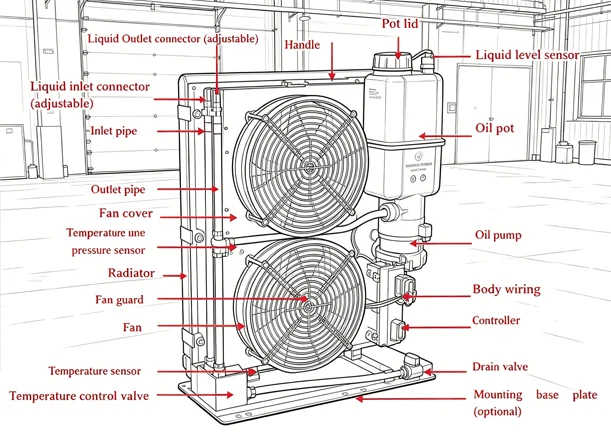
At 2MW power levels, the thermal load on charging modules, cables, and connectors is extreme. The liquid cooling system is not a peripheral accessory—it is the critical enabler that keeps the charger operating at rated output. If cooling performance drops due to low coolant flow, high temperature, or a leak, the charger may apply power throttling to prevent overheating, directly impacting your fleet’s turnaround time.
Industry data indicates that liquid-cooled charging systems have an average service life of at least 10 years, compared to less than 5 years for traditional air-cooled systems. However, achieving that extended lifespan requires disciplined inspection and maintenance. A 2025 IEEE paper notes that active liquid cooling systems “require regular maintenance, increasing the cost”—but that cost is far lower than the downtime and replacement expense of a failed system.
The fundamental question is not whether to inspect, but how often to inspect each component.
The Tiered Inspection Framework for 2MW Liquid Cooling Systems
Manufacturers and industry standards consistently recommend a tiered approach: daily visual checks for operators, weekly and monthly inspections for technicians, and quarterly/annual overhauls for qualified service personnel.
The table below synthesizes recommendations from multiple equipment manufacturers and maintenance guides into a practical framework.
| Frequency | Scope | Key Actions | Responsible Party |
|---|---|---|---|
| Daily | Visual inspection | Check coolant lines for leaks, exterior condition, indicator lights, ambient temperature | Site operator/shift staff |
| Weekly | Basic system check | Coolant level verification, radiator cleaning, pump operation listening | Trained technician |
| Monthly | Performance verification | Coolant quality check, seal inspection, filter cleaning, thermal sensor validation | Qualified service technician |
| Quarterly | Component tightening | All fittings and mechanical bolts torqued; internal dust/debris removal; operational log review | Certified service personnel |
| Annual | Major overhaul | Full coolant replacement; system flush; seal, bearing, and hose replacement; insulation testing; full-load calibration | Manufacturer-certified service team |
Enel X’s JuicePump maintenance manual recommends performing general maintenance at least every six months, with more frequent service required in harsher environments. This baseline aligns with the framework above, where the six‑month mark falls between quarterly and annual service intervals.
Component‑by‑Component Inspection Frequencies
Not all components age at the same rate. The table below breaks down recommended inspection and replacement intervals for each major subsystem of a 2MW liquid‑cooled charger, based on multiple manufacturer sources.
| Component | Inspection Frequency | Replacement Interval | Source |
|---|---|---|---|
| Coolant | Check level weekly; check quality monthly | Every 5 years (or immediately after leak/repair) | Enel X, BTCPower |
| Coolant hoses and fittings | Daily visual for leaks; quarterly for wear | Replace when cracked or deteriorated | POPProbe checklist |
| Coolant pump | Weekly listen for unusual noise/vibration | As needed (bearing wear typically 5–8 years) | POPProbe checklist |
| Heat exchanger/radiator | Monthly visual for corrosion, fouling, damage | Replace if corrosion or physical damage present | POPProbe checklist |
| Charging cables (liquid‑cooled) | Daily visual for outer sheath damage | Approximately every 3 years | BTCPower manual |
| Intake/exhaust filters | Monthly cleaning; inspect during quarterly service | Approximately every 2 years | BTCPower manual |
| Thermal sensors | Monthly validation via management interface | Replace if calibration drifts beyond tolerance | POPProbe checklist |
| Seals and O‑rings | Quarterly inspect for aging/cracking | Replace annually during major overhaul | Liquid‑cooled charger inspection checklist |
| Power module heat sinks | Monthly visual for dust accumulation; thermal imaging annually | Clean as needed; replace if thermal interface material degraded | POPProbe checklist |
Coolant replacement deserves special attention. Multiple manufacturers agree on a 5‑year coolant replacement cycle, with immediate replacement required if there is a leak or after any cooling system repair. Some Chinese industry sources suggest 2–3 years for high‑usage applications and 1.5–2 years for harsh environments. The 5‑year interval appears to be the industry consensus for standard operating conditions.
Daily, Weekly, and Monthly Inspection Checklist
For a 2MW charging station operator, most of the inspection burden falls on daily and weekly checks. These are low‑effort, high‑impact activities that catch problems before they escalate.
Daily Inspection (5–10 minutes per charger)
-
Exterior: Check cabinet for physical damage, water ingress, or unusual bulging
-
Coolant lines: Visual inspection of all visible tubing and quick‑connects for leaks, condensation, or frost
-
Indicator lights: Confirm power, fault, communication, and cooling status LEDs show normal operation (green, no red alarms)
-
Charging cable and connector: Inspect outer sheath for cuts, abrasion, or coolant residue at the connector interface
-
Ambient conditions: Ensure area around radiator panels is clear of debris, and that airflow is unobstructed
-
Operating parameters: Check inlet coolant temperature (normal range: 25–45°C) and system pressure via the HMI or management interface
Weekly Inspection (15–20 minutes)
-
Coolant level: Verify coolant reservoir is within manufacturer‑specified operating range
-
Radiator cleaning: Gently remove dust and debris from radiator fins; in high‑dust environments, this may need to be done more frequently
-
Pump operation: Listen for unusual noise or vibration during operation
-
Electrical terminals: Spot‑check terminals for signs of overheating (discoloration) or looseness
Monthly Inspection (35–50 minutes)
A comprehensive monthly inspection should cover all cooling system components. Industry checklists typically include 36 inspection items across seven sections. Key monthly actions include:
-
Coolant quality check (color, clarity, pH)
-
Thermal sensor validation via management interface
-
Heat sink visual inspection for dust accumulation
-
Hose integrity check (cracks, swelling, deterioration)
-
Heat exchanger corrosion/fouling inspection
Review the thermal management approach used in high-power EV charger power systems
Critical Operating Thresholds and Warning Signs
Knowing what to look for is as important as knowing when to look. The following thresholds apply to most 2MW liquid‑cooled charging systems:
| Parameter | Normal Range | Action Threshold | Consequence of Exceeding |
|---|---|---|---|
| Coolant pressure | 0.2–0.6 MPa | Outside range → shut down for troubleshooting | Reduced flow; potential pump cavitation or line rupture |
| Coolant inlet temperature | 25–45°C | >55°C → immediate load reduction | Power throttling; accelerated component aging |
| Coolant outlet temperature | Varies by design | >65°C → emergency shutdown | Risk of thermal damage to power modules |
| Coolant pH | 7.5–9.5 (typical) | Outside range → replace coolant | Corrosion risk to aluminum/copper components |
Warning signs that require immediate investigation:
-
Red fault indicator on the cooling system status light
-
Coolant leaks (visible drips, puddles, or unexplained coolant level drop)
-
Unusual pump noise (grinding, whining, or intermittent operation)
-
Temperature alarms from thermal sensors via the management interface
-
Coolant discoloration (cloudy, rust‑colored, or containing visible particles)
A 2023 IEEE paper on liquid‑cooled high‑power EV chargers emphasizes the importance of temperature monitoring, noting that diagnostic checks should judge a failure when the measured difference between monitored terminals exceeds a specified value. This reinforces that thermal sensors are not optional—they are the first line of defense against cooling system failure.
Real‑World Scenarios: Two Sites, Different Inspection Needs
Scenario A: Indoor Fleet Depot (Moderate Environment)
-
Location: Indoor warehouse with climate control; 2MW charger operating 8 hours/day, 5 days/week
-
Dust exposure: Low
-
Temperature variation: 15–30°C year‑round
Recommended inspection schedule:
-
Daily visual: Yes (standard)
-
Weekly checks: Yes (standard)
-
Monthly comprehensive: Yes
-
Coolant replacement: Every 5 years (per manufacturer recommendation)
-
Filter replacement: Every 2 years
The moderate environment allows full adherence to manufacturer‑recommended intervals. The primary risk is not environmental but mechanical—pump wear and seal aging over time.
Scenario B: Outdoor Port Facility (Harsh Environment)
-
Location: Coastal port with salt spray, dust, and 24/7 operation; 2MW charger running 16+ hours/day
-
Dust exposure: High (particulate from cargo handling)
-
Temperature variation: 0–40°C; high humidity; salt exposure
Recommended inspection schedule:
-
Daily visual: Yes, with extra attention to corrosion signs
-
Weekly checks: Yes, with radiator cleaning twice weekly in high‑dust periods
-
Monthly comprehensive: Yes, with coolant quality check monthly
-
Coolant replacement: Every 2–3 years (shortened due to harsh conditions)
-
Filter replacement: Annually (shortened from 2‑year standard)
Industry guidance confirms that in harsher environments, “you should perform general maintenance more often”. The salt spray environment also demands more frequent inspection of metal components for corrosion.
See the configuration examples for ultra‑fast charging power systems for new energy vehicles
Quarterly and Annual Overhaul—Beyond Routine Inspection
Routine daily/weekly/monthly inspections catch developing issues, but they do not replace the deeper maintenance that should occur quarterly and annually.
Quarterly Maintenance (Every 3 months)
-
Tighten all pipe fittings and mechanical mounting bolts—operational vibration can loosen fittings over time
-
Remove internal dust and moisture from the cabinet; check circuit boards and power modules for condensation or dust accumulation
-
Review operational logs to identify recurring fault patterns and address root causes
Annual Major Overhaul
The annual service is the most comprehensive. Based on industry practice:
-
Full coolant replacement: Drain, flush the entire cooling loop to remove internal scale and contaminants, and refill with fresh coolant
-
Consumable replacement: Replace aging seals, worn pump bearings, and fatigued hoses
-
Insulation testing: Verify module and cable insulation integrity to prevent leakage and short‑circuit risks
-
Sensor calibration: Recalibrate temperature, pressure, and flow sensors
-
Full‑load test: After maintenance, run the charger at rated 2MW output to verify all parameters meet specifications before returning to service
The annual overhaul is the single most important maintenance event for extending the service life of a 2MW liquid‑cooled charger from the typical 3–5 years of an air‑cooled system to 8–10 years or more.
Next Step: From Inspection Schedule to Equipment Evaluation
By now, you should have a clear framework for inspecting the liquid cooling system on a 2MW EV charger module—daily visual checks, weekly system verification, monthly comprehensive inspection, quarterly tightening, and annual overhaul with coolant replacement. The actual comparison of specific charger modules should include an evaluation of how accessible each component is for inspection, whether the manufacturer provides clear maintenance documentation, and what the recommended service intervals are for that specific design.
When you are ready to evaluate specific 2MW charging solutions, start by reviewing the maintenance access provisions—can you reach the coolant reservoir, pump, and heat exchanger without disassembling half the cabinet? These practical considerations will influence your total cost of ownership as much as the initial specifications.
Related Reading
-
Liquid‑Cooled vs Air‑Cooled 2MW Chargers: Total Cost of Ownership Comparison
-
Coolant Selection and Chemistry for High‑Power EV Charging Systems
-
Thermal Sensor Calibration and Fault Diagnosis for Megawatt Chargers
-
Designing for Serviceability: Maintenance Access in Containerized Charging Systems
-
Predictive Maintenance for EV Charging Infrastructure Using IoT Sensors